
Brown, Yellow and Orange Diamonds: Beyond Champagne and Cognac
By Cyrille Deloubrière, Certified Expert Gemologist (EIG Monaco)
Brown, yellow and orange are the warm side of the diamond world. They are the colors I work with most, and the ones most often reduced to two words: champagne and cognac. This guide explains where these colors really come from, why those two words say so little, and how GEA chose to speak about them differently.
Where warm colors come from
Three different causes, sometimes at work in the same stone:
- Yellow: nitrogen. Almost every natural diamond contains traces of nitrogen. When enough of it gathers in specific configurations, the stone absorbs blue light and shows yellow. Most fancy yellow diamonds owe their color to a nitrogen defect known to gemologists as the "cape" series, a name inherited from South Africa's Cape Province, the first great source of yellow diamonds.
- Brown: pressure. Brown does not come from an impurity but from the crystal itself. On its way from the depths of the earth, the diamond is deformed by stress and heat; this plastic deformation leaves tiny defects in the lattice, and those defects absorb light as brown. Under magnification, it often appears as fine parallel lines called graining.
- Orange: a narrower path. Orange is also linked to nitrogen, but the absorption extends further toward the red end of the spectrum. A pure orange diamond, with no other color, is extremely rare.
Because these causes can coexist, warm diamonds are rarely one color. A stone can be yellow with brown, brown with orange, or orange with yellow. That blend is exactly what makes each one different.
Reading the blend on a certificate
A laboratory report names the color from right to left: the last word is the dominant hue, the words before it are modifiers. The suffix -ish signals a weaker modifier; without it, the second color is almost as strong as the first.
Two stones from the GEA selection show the difference:
- Fancy Deep Brown Orange, 1.12 ct: orange and brown in near balance.
- Fancy Deep Brownish Orange, 1.13 ct: orange clearly leads, brown only tints it.
On paper, one word separates them. In the hand, they are two different stones. The intensity grade (Fancy Light, Fancy, Fancy Intense, Fancy Deep, Fancy Dark) then tells you how saturated and how deep that blend is. For the full grading scale, see Fancy Color Diamonds: A Gemologist's Guide.
Where they come from
Warm diamonds are found in most diamond-producing regions, including southern Africa, Siberia and Australia. Two sources shaped their history:
- South Africa, where the first diamond found in the region, the Eureka, discovered in 1867, was yellow, and where light yellow stones were so common that "cape" became their trade name.
- The Argyle mine in Western Australia, which operated from 1985 to 2020 and became the world's largest producer of brown diamonds.
A laboratory report confirms that a diamond and its color are natural. It does not normally state the mine. Origin, for most stones, remains part of their mystery.
Why "champagne" and "cognac"
For a long time, brown diamonds were considered industrial material. In the 1980s, Argyle needed a way to sell its large production of brown stones, and gave them a new vocabulary: champagne for the lighter tones, cognac for the deepest. The mine even created its own scale, from C1 to C7.
It worked. But these are marketing names, not laboratory grades. No independent laboratory uses them, and they do not tell you the one thing that matters: what the color is made of. A "cognac" can be brown with orange, brown with yellow, or almost pure brown. The same word covers stones that look nothing alike.
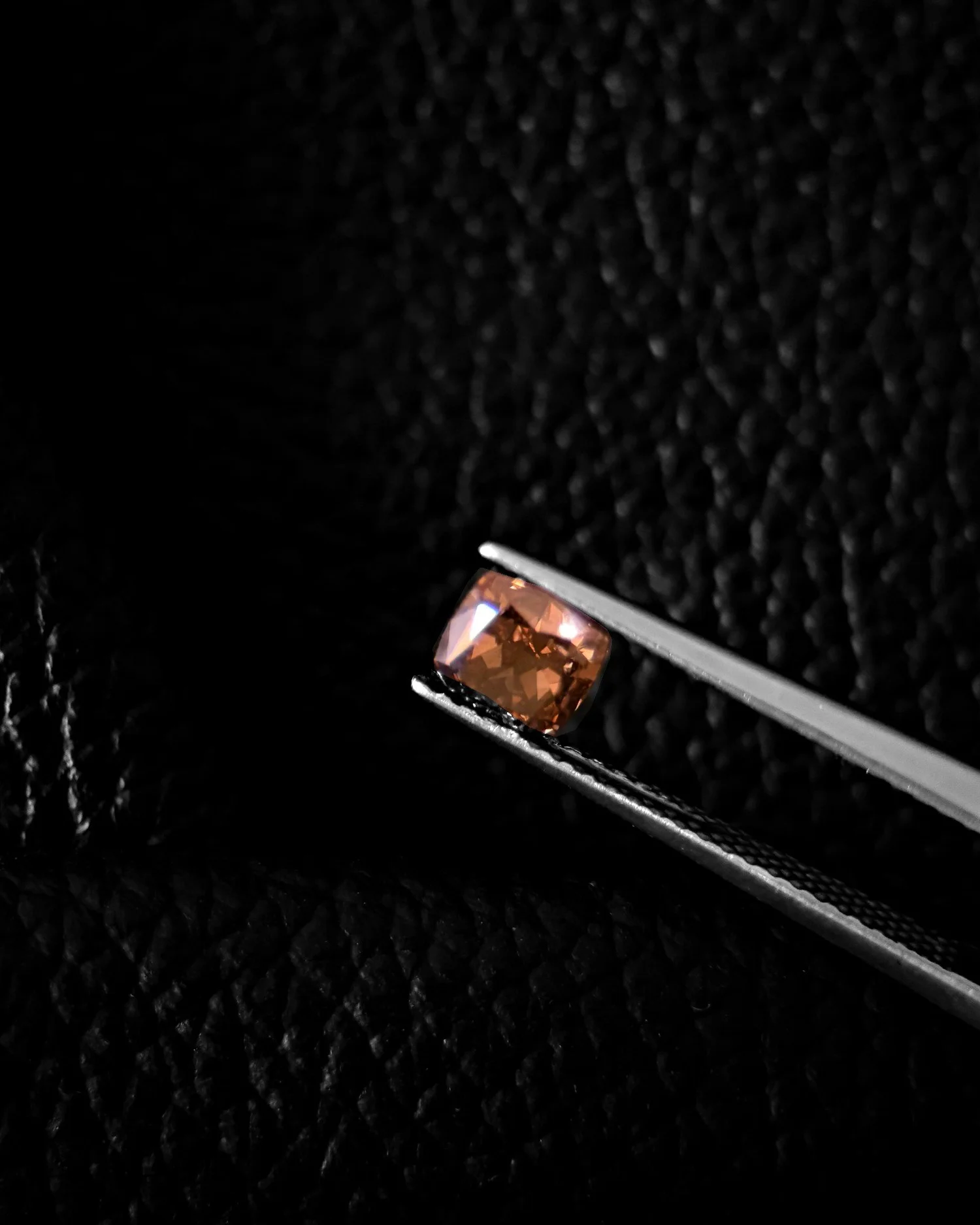
Fancy Deep Brown Orange, 1.12 ct, IGI certified: the stone that will become ECHØ | Terra.
How GEA speaks about color
At GEA, a stone is described on three levels.
The certificate. A loose stone keeps the laboratory's words, and nothing else. Fancy Light Brown Yellow, 0.71 ct, VVS2 is precise, verifiable, and enough.
What it evokes. When I study a stone, I note what it gives back to the eye: Quiet Warmth, Inner Fire, Earthy Depth. Not a name, a feeling.
The ring. Only when a stone is set does it receive a name, one meant to translate the real composition of its color better than champagne or cognac ever could:
- ECHØ | Ember, Fancy Orangy Brownish Yellow, 1.00 ct, Asscher cut: a yellow veiled in brown, with orange glowing beneath like an ember.
- ECHØ | Sienna, Fancy Intense Yellowish Brown, 0.61 ct: a saturated brown warmed by yellow, the color of raw sienna earth.
- ECHØ | Dune, Fancy Brown Yellow, 0.82 ct: yellow and brown almost in balance, like sand shifting with the light.
And for the stones still waiting for their ring:
- Veil, Fancy Light Brown Yellow, 0.71 ct: a light yellow under a fine layer of brown, like light through fabric.
- Terra, Fancy Deep Brown Orange, 1.12 ct: brown and orange in balance, the color of fired earth.
- Lichen, Fancy Intense Greenish Orangy Yellow, 0.43 ct: a yellow touched by orange, with the green trace that gives it its name.
The words change; the method stays the same: start from the stone, and let the name follow its color.
Frequently asked questions
Is a champagne diamond the same as a brown diamond? Yes. "Champagne" and "cognac" are trade names for natural brown diamonds, usually with yellow or orange modifiers. On a laboratory report, the same stone is described as Fancy Light Brown, Fancy Deep Brownish Orange, and so on.
Are brown diamonds natural? Most are, and brown is the most common fancy color in nature. Brown can, however, be modified or removed by treatment, which is why a laboratory report confirming natural color matters.
What is the difference between a yellow and an orange diamond? Both owe their color mainly to nitrogen; orange appears when the absorption extends further across the spectrum. Pure orange is far rarer than yellow, which is why most stones carry orange as a modifier rather than as the main color.
Is a brown diamond a good choice for a man's engagement ring? It is one of the most natural choices. Its warmth reads as depth rather than sparkle, and no two stones share the same blend of color.